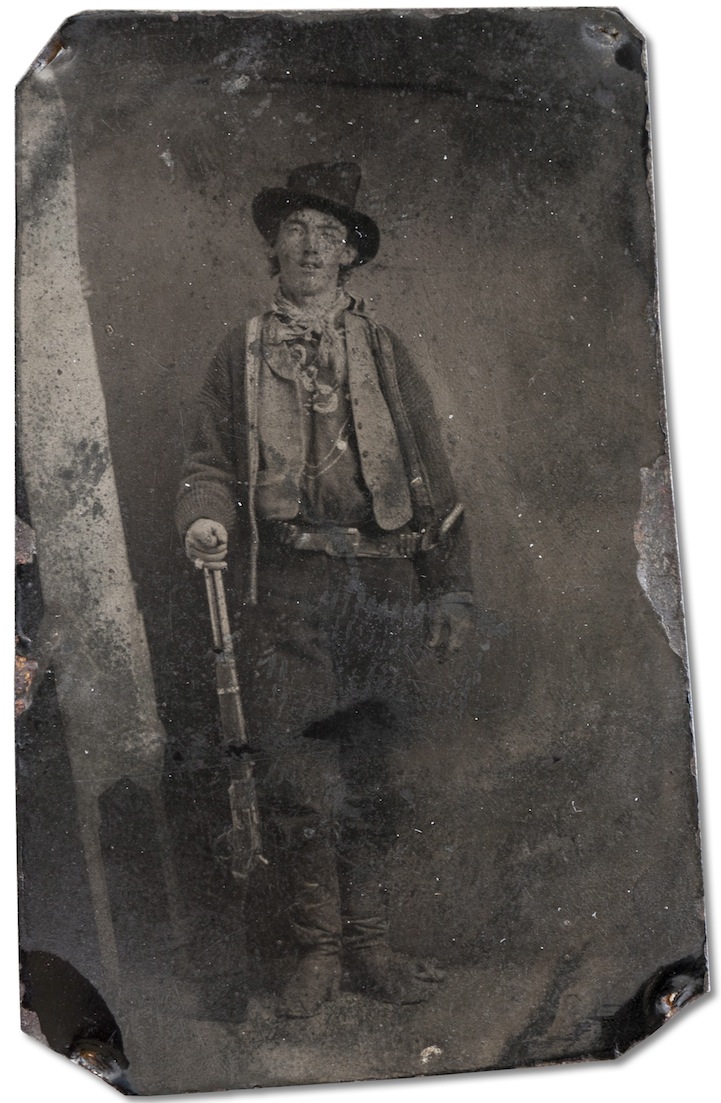

Before Billy the Kid became a problem for sheriffs, his mother was helping organize a town. In July 1870, Catherine McCarty signed the petition asking that Wichita, Kansas, be incorporated. She was a laundress, a landowner and the only woman among 124 signers. W. H. Antrim, whom she would marry three years later in Santa Fe, signed beside her. Her son Henry would find a rather different route into the history books.[1]
Catherine usually enters the Billy the Kid story just in time to die. Tuberculosis took her in Silver City, New Mexico, in 1874, leaving two sons and a husband who appears to have had little appetite for raising them. The Wichita petition lets us meet her before the tragedy: working, owning property and having a say in what the town ought to become.[1][2]
The family tree needs an eraser
Louis Abraham, who knew the family in Silver City, remembered her as “a jolly Irish lady, full of life.” Historian Richard W. Etulain quotes him and describes a mother who encouraged Henry and paid attention to his upbringing. When she died, the boy lost the parent he could count on.[2]
Her Irish origins are widely accepted. Try filling in the rest of the family tree, though, and the pencil soon gives way to an eraser. Robert M. Utley’s American National Biography entry says Henry was probably born in Brooklyn to Irish immigrants. That “probably” is doing honest work. His father’s identity, Catherine’s maiden name and her birthplace in Ireland remain disputed.[3][4]
The Texas State Historical Association offers a proposed New York identification: Patrick McCarty and Catherine Devine as his parents. The University of Nebraska-Lincoln’s Encyclopedia of the Great Plains points instead to an 1880 census entry giving Missouri as the birthplace of Billy and both parents. A tidy, generally accepted family tree has yet to emerge from that paperwork.[5][6]
PBS places Catherine among the emigrants who fled the Great Hunger. The timing fits. A particular ship, departure date or Irish parish cannot be securely attached to her from the evidence examined here. Anyone offering an exact village should be prepared to show the record.[7]
Catherine signs on the dotted line
Wichita gives us firmer ground. The Midwest Historical & Genealogical Society places Catherine’s property near today’s 21st and Oliver, with Antrim’s acreage across the road. It also supplies a useful brake on the storytelling: the society found no official local record of Henry. His mother’s place in Wichita is better documented than his.[1]
The paper trail resumes at the First Presbyterian Church in Santa Fe, where Catherine married Antrim on March 1, 1873. County records cited by the Texas historical association put Henry and his brother Joseph at the wedding. The family moved on to Silver City. Antrim worked in the mines; Catherine died on September 16, 1874.[5]
Henry was still a boy. Antrim went prospecting and, in Etulain’s account, effectively abandoned his stepsons. Henry drifted into theft and eventually fled New Mexico. He used Antrim’s surname for a while, then adopted William H. Bonney. Keeping up with his names would become a small research project of its own.[2][3]
Did Billy the Kid speak Irish?
Here is the tale that gives an Irish reader reason to put down the coffee. In True West in June 2015, researcher Chuck Usmar described a 1954 interview with Clark Hust, who had worked as a boy for Irish immigrant rancher Pat Coghlan. Hust remembered Mary, a niece visiting the childless Coghlans from Ireland. She spoke no English. According to Usmar’s account of the interview, Billy interpreted between her and the ranch hands.[17]
Usmar also found a newspaper notice of the visit and two nieces named Mary in Coghlan’s will. Those are useful supporting details. Neither tells us which language came out of Billy’s mouth.[17]
Hust’s recollection was recorded more than seventy years after Billy’s death. If accurate, it suggests conversational Irish, also called Gaeilge or Irish Gaelic. It does not establish fluency, identify his teacher or prove he learned it from Catherine. We have not independently examined the interview itself. It is a fascinating lead; it is not a language certificate.[17]
The man from Galway
The next Irish connection comes with no room for a wink. In August 1877, Henry Antrim shot Frank P. Cahill near Camp Grant in Arizona. Later histories describe Cahill as a bully who repeatedly picked on him. A newspaper report from shortly after the shooting preserves something those accounts can lose: the dead man had a history and a family, too.[3][8]
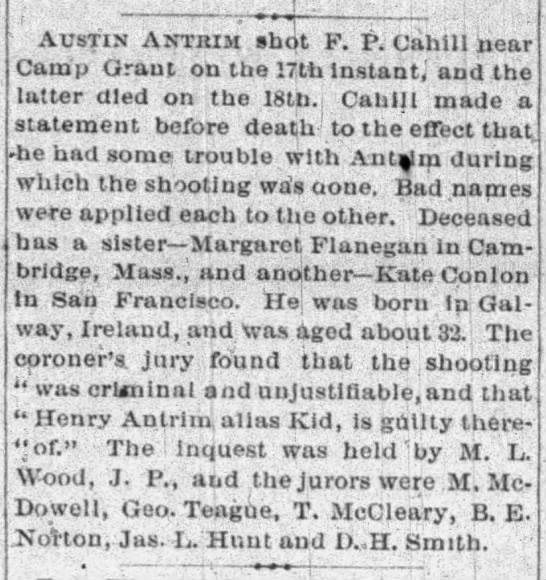
The clipping, identified by its hosting historical society as the Arizona Citizen of August 25, says Cahill was born in Galway and was about 32. It names his sisters: Margaret Flanegan in Cambridge, Massachusetts, and Kate Conlon in San Francisco. A coroner’s jury found the shooting criminal and unjustifiable, the report says.[8]
The newspaper is not a flawless witness. It starts with “Austin Antrim” and later calls the shooter “Henry Antrim, alias Kid.” It dates the shooting to August 17 and Cahill’s death to the next day. A coroner’s finding was not a trial verdict; this clipping cannot settle the fight’s circumstances. It does restore a Galway man, with sisters on opposite sides of America, to a story usually told around his killer.[8]
The House always wanted to win
Back in New Mexico, Billy went to work for John Tunstall, an English rancher and merchant establishing himself in Lincoln County. Tunstall and Scottish-Canadian lawyer Alexander McSween challenged the business interests of Lawrence Murphy and James Dolan, both Irishmen. Murphy and Dolan’s imposing store went by “The House.” In Lincoln, a shop could be much more than a place to buy supplies.[9][4]
Government contracts supplying Fort Stanton and the Mescalero reservation helped underpin the older company’s power. New Mexico Historic Sites describes prices and credit being used to drive farmers and ranchers into debt. Add competing claims over the estate of Murphy’s former partner Emil Fritz, and influence over local law enforcement, and the accounts were becoming dangerous in more than a bookkeeping sense.[10]
Tunstall was killed in February 1878. Billy joined the Regulators, pursuing men they held responsible. Sheriff William Brady and Deputy George Hindman were killed in an ambush on Lincoln’s main street; Billy was later convicted of Brady’s murder. An Irish family background did not put him on an Irish team. His employer had been English, and Irish merchants stood among his enemies. Money and allegiance drew their own borders.[4][5]
Nor was his world confined to immigrants from across the Atlantic. Etulain stresses his friendships with Hispanic companions. Billy arrived in New Mexico communities whose families and languages had shaped the place long before he appeared in it.[2]
Dear Governor: about that pardon
Billy also wrote letters. Territorial governor Lew Wallace received his correspondence about a possible pardon in exchange for testimony concerning the Lincoln County violence. The Indiana Historical Society now holds letters from those dealings. Wallace never supplied the pardon. He did preserve the paperwork.[11]
One loose sheet in the Wallace papers remained unidentified until historian Gale Cooper attributed it to Billy. Signed “Billie,” it was the end of a letter whose beginning had disappeared. The society says Cooper used the handwriting and embossed stationery, also found on other Bonney letters, to identify it and date it to March 24, 1879. Even his correspondence needed a detective.[11]
By December 12, 1880, he was taking issue with his press coverage. A newspaper had made him captain of a band of outlaws; his letter to Wallace disputed it. He also set out his version of Jim Carlyle’s death during an attempted capture, insisting that the men surrounding the house had shown no legal papers. This was an accused man arguing his own case, not an impartial report. But he was certainly reading the papers.[12]
The Albuquerque Museum’s exhibition documentation lists two more Bonney-to-Wallace letters in the New Mexico History Museum collection, including one dated March 29, 1881. Billy was again a prisoner, still seeking help from the governor.[13]
Dead at Fort Sumner, busy in print
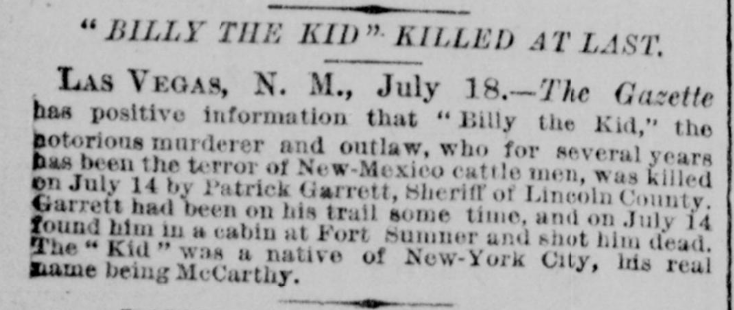
Pat Garrett killed him at Fort Sumner on July 14, 1881. Five days later, the New-York Tribune ran a short report headed “Billy the Kid” Killed at Last. It called him a notorious murderer, described him as a New York native and named him McCarthy. News of his death traveled east with a compact biography that readers had little chance to check.[14]
Garrett’s The Authentic Life of Billy, the Kid followed in 1882, with Ash Upson’s assistance. “Authentic” was a confident word for the cover. Garrett promised to correct newspaper and cheap-novel falsehoods, yet his opening chapter gave a childhood chronology at odds with the later-documented date of Catherine’s marriage. The book’s precise New York birth date, November 23, 1859, became another disputed detail. Precision and proof are different things.[15][5]
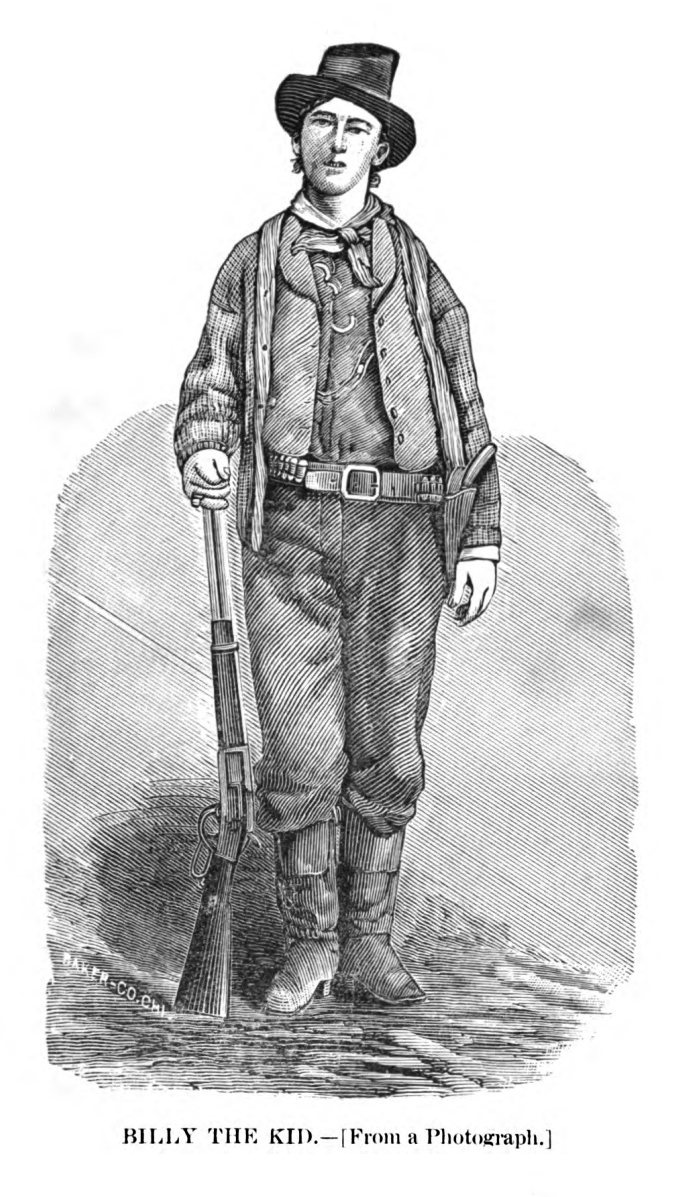
The engraved frontispiece helped send the familiar young man with a rifle into circulation. Pictures said to show Catherine have had a less secure career. Roy B. Young and Kurt House traced misidentifications and rival claims in their research on the supposed portraits. No authenticated photograph of her is presented here.[16]
A signature worth remembering
Catherine never saw the notoriety: the jail escape in the papers, Garrett’s killing of her son, the books that came after. Her own record survives in smaller pieces, including a marriage entry, accounts of work and land, a petition signature and other people’s memories.[1][2][5]
The Irish-language story remains tantalizing. It describes a ranch visitor who needed an interpreter and a young man who, according to a much later recollection, could help. If Hust remembered correctly, Irish had found an unlikely speaker in New Mexico. Whether Catherine taught it to her son is still an open question.
For all the ink spilled over Billy, his mother leaves us with one unusually clear picture: a working woman signing her name to the future of a town. One McCarty helped make Wichita. The other helped keep biographers busy. The family tree has room for both.