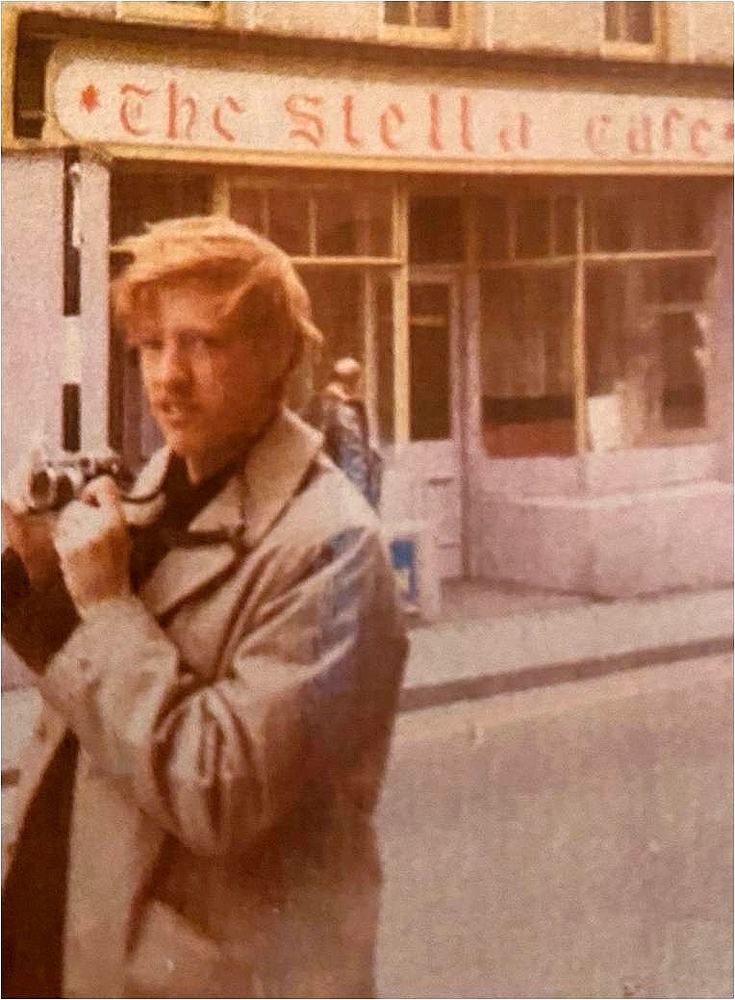
A newspaper has two lives. One is printed: the headlines, the bylines, the photographs, the date at the top. The other is carried around by the people who made it. For the Irish American Post, that second life includes family trips to Ireland, an early office in Milwaukee’s Third Ward, papers delivered across the city, and conversations that did not always end when the glasses were empty.[1]
The Irish American Post was founded in Milwaukee in 1990 by Loren Martin “Marty” Hintz, the journalist and travel writer who became a stalwart of the city’s Irish American community. His son Stephen, now the Post’s publisher and editor, remembers a publication woven into the family’s working life. Writing, traveling and getting the paper into readers’ hands all belonged to the same enterprise.[1][2]
A newspaperman with somewhere else to go
Marty came to Milwaukee in 1967 to work at the Milwaukee Sentinel. He had grown up in New Hampton, Iowa, studied journalism at the University of St. Thomas and earned a master’s degree at Northwestern. In 1975 he went freelance. The Wisconsin Newspaper Association’s remembrance follows that progression from newsroom work into a remarkably productive writing career.[2]
The newsroom gave him a trade; travel gave him an inexhaustible supply of subjects. In his 2020 Shepherd Express remembrance, editor David Luhrssen recalled a writer able to take on subjects well beyond a narrow specialty. His output included travelogues and accounts of faraway places, along with books written with Pam Percy. More than 125 books appears in the remembrances, with Northwestern’s Medill magazine explicitly attributing that total to the family.[3][4]
He also helped lead his profession. A September 2002 letter to Bermuda’s Royal Gazette carries his signature as president of the Society of American Travel Writers. Its subject was hospitality: thanking the island for looking after travel writers stranded when the September 11 attacks disrupted their departure. Behind the professional title was a writer who understood that a place is often remembered through the people who help you there.[5]
Home on Grant Boulevard
For all the traveling, the family story has a firm Milwaukee address. Stephen remembers Marty raising his family on Grant Boulevard in the Sherman Park neighborhood. St. Ben’s church was part of the family’s Irish Catholic life. Home, parish and neighborhood gave the journeys a place to return to.[1]
Ireland was a relationship
For Marty, Ireland became a place to return to. Stephen remembers repeated journeys, with members of the family traveling and writing for the Post. Ireland entered family life as somewhere people went, worked, listened and came back from with more to tell. Those journeys kept the connection alive across generations.[1]
The published books show another part of that commitment. In Irish Milwaukee, issued by Arcadia in 2003, Marty assembled a photographic history connecting immigrant life with the city’s continuing Irish culture. Celebrate the Legend: 25 Years of Milwaukee Irish Fest, 1981–2005 turned his attention to the festival and the people who sustained it. Ireland and Milwaukee were subjects he could approach from either shore.[6][7]
Stephen also remembers his father’s feeling for Ireland’s long struggle for self-determination: an admiration for its national identity, its persistence and its determination to speak in its own voice. That fighting spirit belonged to Marty’s affection for the country alongside its music, its humor and its hospitality. It gave the family’s connection a historical and political depth.[1]
Nash’s, Jim Hegarty’s, and the conversation between songs
Nash’s Irish Castle and Jim Hegarty’s belong to Stephen’s recollection of that Milwaukee world. He remembers them as part of the social world around his father and the Post, places where a community met face to face and conversation could become a connection worth keeping.[1]
Irish Fest founder Ed Ward’s firsthand account of the 1970s music circuit names Nash’s Irish Castle and Jim Hegarty’s among a small constellation of local venues. His story describes how pubs brought musicians and listeners together before the festival grew into its familiar lakefront scale. The city’s Irish cultural life had places to gather, and those gatherings helped give it momentum.[8]
There was whiskey, too. Stephen remembers it among the pleasures of his father’s Irish world, along with the talk and the company. Marty also made drinking culture a subject of professional inquiry: A Spirited History of Milwaukee Brews & Booze belongs on his bibliography. The convivial writer and the working reporter could occupy the same chair.[1][9]
The festival, and the people who made it
Milwaukee Irish Fest gave those connections a larger public stage. Medill’s remembrance identifies Marty as the festival’s first publicist; the Wisconsin Newspaper Association describes him as a co-founder. He helped make the event known and later helped put its history into print. That combination of organizing, promoting and recording is part of what made him a pillar of Irish Milwaukee.[2][4]
In a 2010 account, IrishCentral relayed his description of the festival as an extended family, drawing on an earlier interview. The idea fits the Post’s own family history. Music and celebration made the public occasion; relationships and repeated work kept it going from one year to the next. The people behind the event were a subject worthy of the same attention as the performers.[7]
An office in the Third Ward, and a paper on the move
Stephen places the Post’s first office in the Third Ward, before the neighborhood acquired the polished identity visitors know today. He remembers the beginning of a working newspaper in a changing part of the city, with the family contributing to the writing, travel and deliveries.[1]
An old directory gives that memory a useful documentary companion. Ceolas’s list of North American Irish periodicals, last updated in March 2002, records the Post at 301 N. Water Street. It describes a bimonthly magazine with Midwest coverage and bureau news from Ireland. The listing catches a Milwaukee publication reaching across the Atlantic while keeping its address on Water Street.[10]
The publication also had collaborators whose work belongs in its history. Mukwonago Community Library’s biography identifies writer Malcolm McDowell Woods as a co-founder and managing editor of the Post. In January 2002, the University of St. Thomas independently identified Marty as its executive editor and publisher. A community paper depended on the people who supplied its pages as well as the person whose name led the masthead.[11][12]
Circulation was a family verb
For the Hintz family, the Post was something you helped make and then helped move. Stephen recalls relatives writing for it, traveling for it and delivering copies around Milwaukee. There was the adventure of going to Ireland, and there was the practical obligation to get the finished issue out into the city. Both were work the family shared.[1]
That is an important part of the paper’s lore. A publication can be described by its territory, its frequency or its editorial interests. The family remembers the labor as well: somebody had to write the story, somebody had to finish the issue, and somebody had to deliver it. The printed masthead could not hold every contribution.
A legacy still in circulation
Marty died on September 20, 2020. His name was added to the Milwaukee Press Club’s posthumous Media Hall of Fame class in 2022. That recognition gives formal expression to what readers and colleagues had known through years of work: he had helped tell the story of this city while continuing to look beyond it.[4][13]
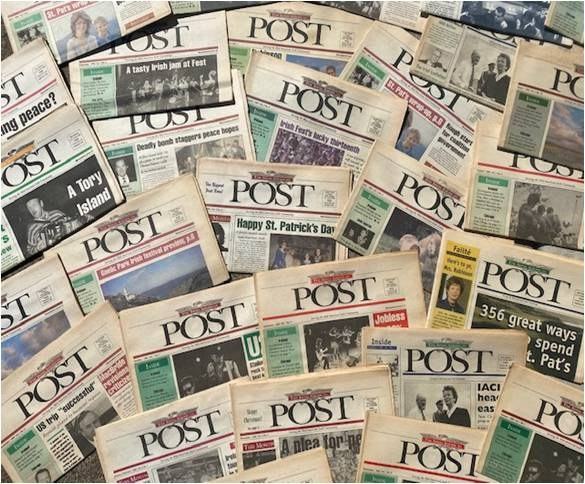
The Post’s memorial writing scholarship carries his interest in new writers forward. Its restored newspaper archive keeps earlier contributors and stories available. Stephen’s continuation of the publication brings the family connection into a different publishing era.
The address and the means of delivery have changed. The founding impulse is easy to recognize: go somewhere, pay attention, find the people who make a place itself, and bring back a story worth sharing. Around Milwaukee, across Ireland, and wherever the next assignment led, Marty made a life of it. The Post is one of the things he left in circulation.