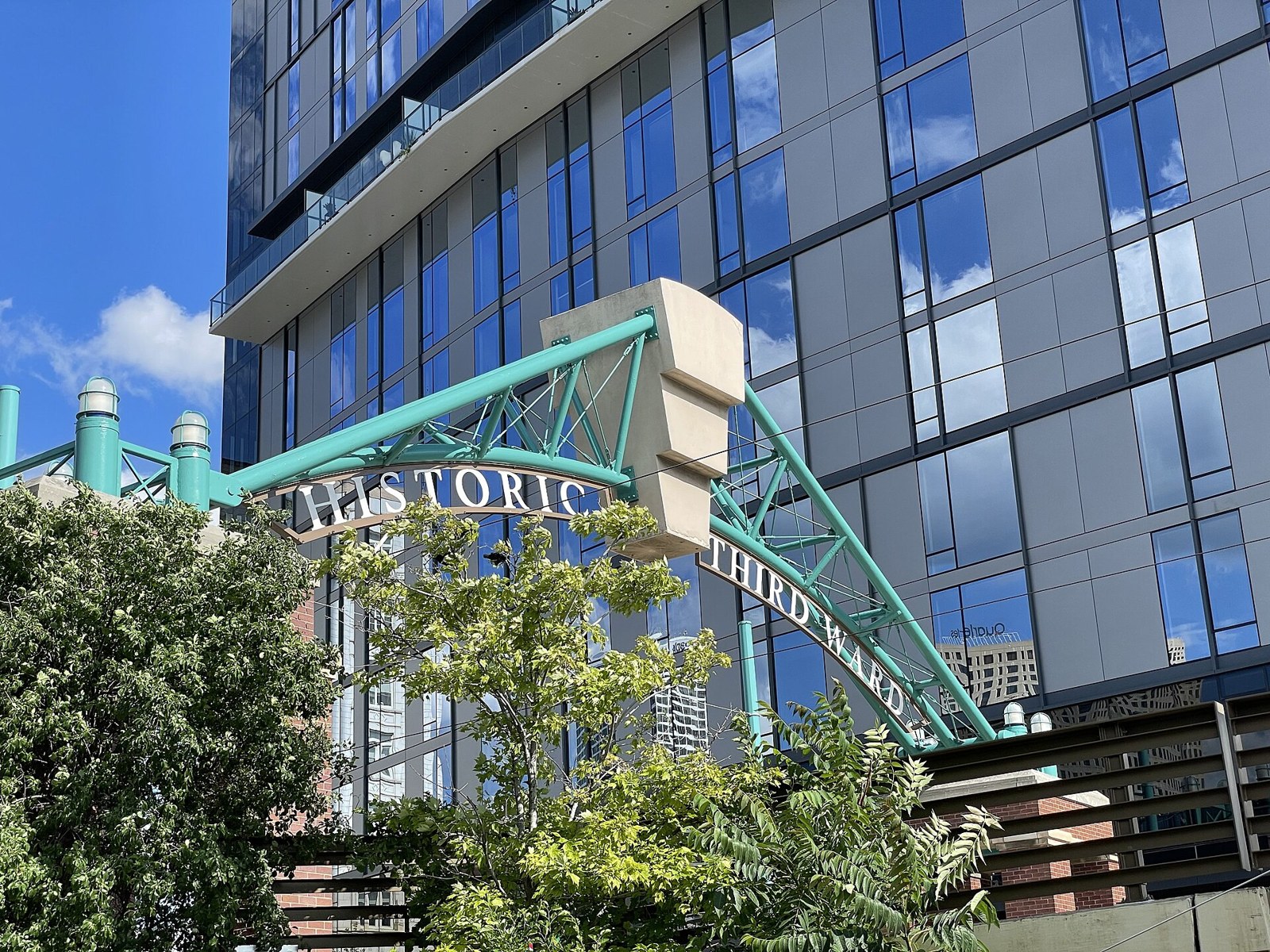
The Third Ward is very good at looking expensive. Brick warehouses, handsome windows and an afternoon’s worth of places to stop can make it easy to forget that the neighborhood once ran on hard physical work and inexpensive rooms. Before the boutiques, much of this part of Milwaukee had an Irish accent.
The Irish did not arrive in an empty landscape. Milwaukee PBS’s history places the city’s Indigenous communities before European settlement and describes Irish immigrants clustering between the river and the lake. By 1850, it reports, Irish immigrants accounted for roughly 15 percent of Milwaukee’s population. That is a citywide figure, not a claim that the whole Third Ward shared one birthplace.[1]
First, make some ground to stand on
The waterfront offered employment, but it did not offer everyone a dry, comfortable address. In WUWM’s 2021 interview, local historian Carl Baehr describes laborers cutting down river bluffs and moving the material into marshes. People who helped make buildable land could still find themselves living in unhealthy surroundings. Baehr’s account includes crowding, poverty and cholera. This was not a picturesque hardship-themed village.[2]
Architectural historians describe Irish railroad, factory and warehouse workers living in small frame cottages toward the marshy lakeshore. The smart masonry buildings admired today should not simply be imagined as those workers’ original homes. The neighborhood’s present appearance owes a great deal to what happened after a devastating fire.[3]
Even “the Irish neighborhood” is a useful shorthand with limits. Families, trades and fortunes differed. Some residents labored for wages; others ran businesses and took roles in public life. A boardinghouse could put several occupations under one roof. One surviving building gives us a way to follow that variety without turning everybody into a statistic.
Meet Catherine Foley, who had a building to run
Catherine Foley was an Irish immigrant widow. The city’s designation study traces her business through directories and tax records. An 1880 directory places “Kate” Foley at the old 112 Erie Street address, with a seamstress daughter, laborer brother and sailor boarder. Working Milwaukee shared a front door.[4]
In 1884–1885, she built a brick saloon and boardinghouse at today’s 266 E. Erie Street. The city study cites a March 20, 1884, Milwaukee Sentinel item about building-material permission for a $3,000 brick house. Tax records place construction across those two years. Her work as a businesswoman has left a substantial paper trail.[4]
The address, business and construction records let us follow her without guessing at her finances. Her building survived the catastrophe that helps explain the disappearance of so much of the old residential ward.[4][5]
The Lady Elgin: a terrible loss, and a caution about numbers
On September 8, 1860, the Lady Elgin sank after colliding with the schooner Augusta while returning from Chicago. Hundreds died, including many members of Milwaukee’s Irish community. Wisconsin Public Radio’s historical account connects the excursion with the Third Ward’s Irish Union Guard.[6]
It is tempting to give one terrible night the job of explaining everything that followed. The Milwaukee County Historical Society warns that the wreck’s place in local memory has sometimes been overembellished. Its collection contains a timetable, a song sheet, newspaper clippings and other material: ways of getting back to the people and the event rather than simply enlarging the legend.[7]
Accounts do not all agree on totals, and passenger counts, total deaths and Irish deaths are too often shuffled into one impressive number. The disaster wounded families and civic networks. It did not make the Irish vanish from Milwaukee, and it cannot by itself explain generations of neighborhood change. That larger story includes housing, work, migration and later destruction on land.
October 28, 1892: the streetscape changes
Fire broke out in the Third Ward on October 28, 1892. The Wisconsin Historical Society’s marker identifies the Union Oil and Paint warehouse at 323 N. Water Street as the starting place. Its account describes sixteen blocks and hundreds of buildings destroyed, with more than 1,900 people left homeless. Even without choosing the largest figures in circulation, the scale is staggering.[8]
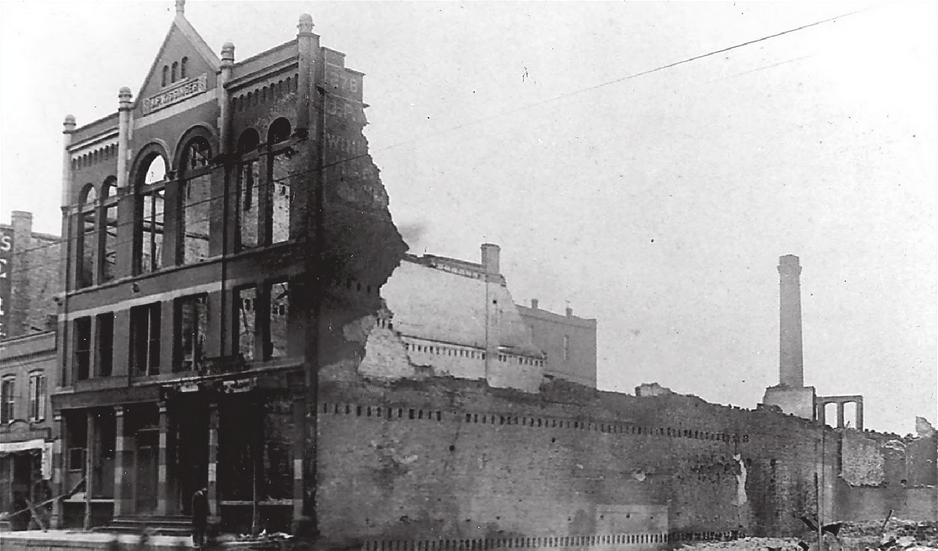
Published death and displacement counts differ. The historical marker and later histories should not be made to agree by quietly mixing their figures. What they do agree on is the destruction of a residential world and the importance of the rebuilding that followed. The surviving warehouses tell that later story as much as the earlier immigrant one.[3][8]
Irish households established themselves elsewhere in Milwaukee. City neighborhood surveys trace movement to the East Side and westward to Tory Hill and Merrill Park. The Third Ward became an important Italian neighborhood in turn. That community would face its own losses through demolition and highway construction. The neighborhood was never a stage set handed from one group to another without consequences.[9][10]
One tavern, several Milwaukee histories
Foley’s building remained, but it did not remain frozen in the 1880s. Milwaukee Preservation Alliance’s history follows its sale to Miller Brewing in 1896, its later life as the Wreck Room, an LGBTQ leather bar from 1972, and its use as a Milwaukee Institute of Art and Design student union from 1996. A 2013 fire damaged it. Each chapter adds people whose history deserves more than a passing footnote.[5]
General Capital Group and Joseph Property Development donated the property to Milwaukee Preservation Alliance in January 2024. The organization’s project page describes stabilization and restoration plans, with a future historical exhibit, preservation resources and leasable space. Those are plans for a public future, not an invitation to walk into an already completed museum.[11]
A July 2026 UWM Architecture account also describes Adam Thibodeaux’s Ghost Lab work exploring the building’s overlooked histories. The current effort is a reminder that preservation involves deciding whose experiences a building gets to represent, as well as which bricks to repair.[12]
A different way to take a walk
On your next Third Ward walk, try looking past the pleasant frontage. Ask which buildings predate the fire and which belong to the rebuilding. At Erie Street, notice that the small tavern’s story holds an immigrant businesswoman, boarders, brewery ownership, LGBTQ community life and art students. An address can contain more Milwaukee than a tidy neighborhood label allows.
View restoration sites from public areas and check the owner’s information before planning a visit. The Foley project is not advertised here as a walk-in attraction. For another building carrying several chapters of the city’s life, read our St. Brigid Center follow-up.
The boutiques are part of the Third Ward’s story now. They are simply late arrivals. Catherine Foley was taking care of business long before the neighborhood learned to sell a lifestyle.