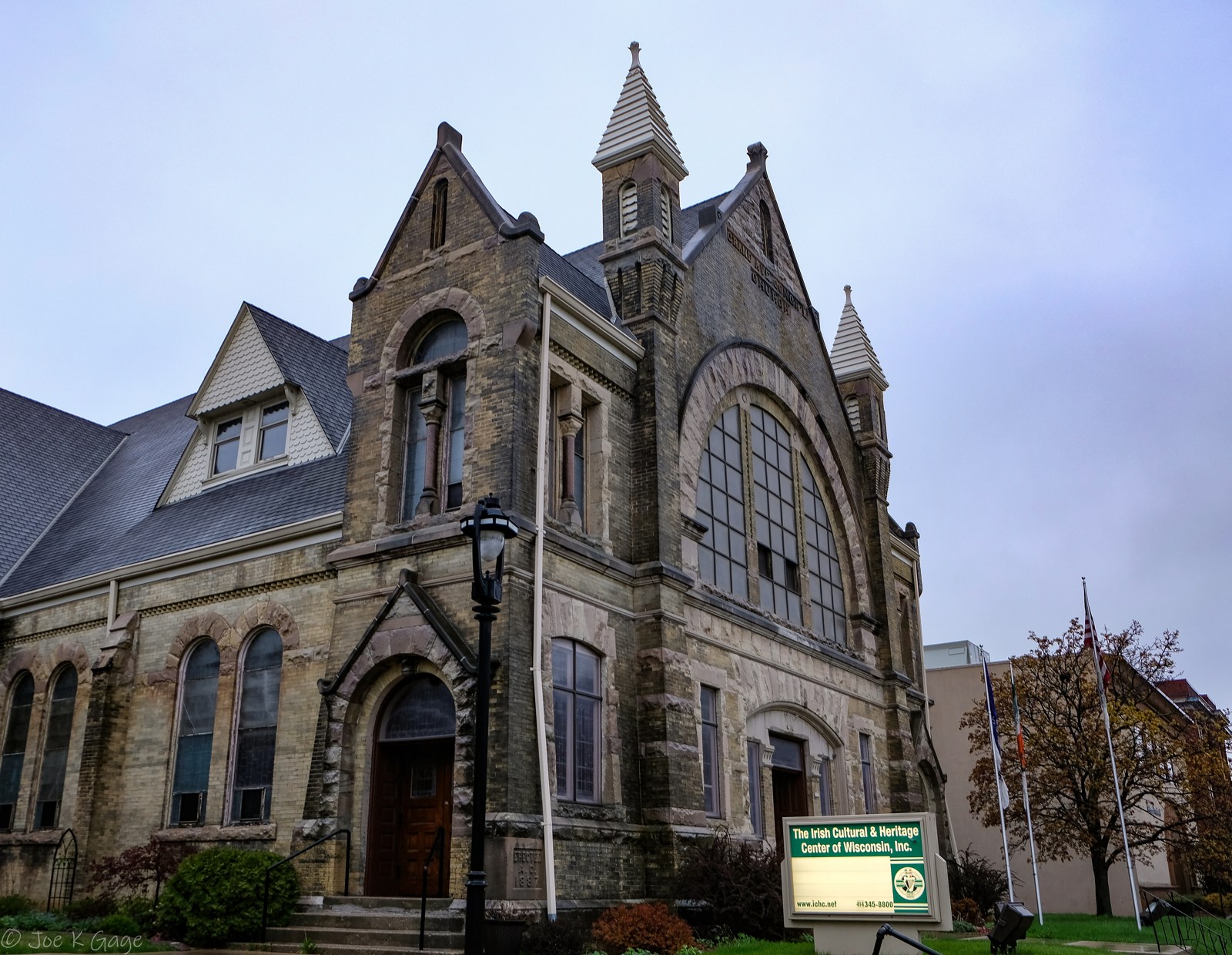
Milwaukee’s old Irish Cultural and Heritage Center has a new online name: St. Brigid Center for Irish Arts and Culture. The address remains 2133 W. Wisconsin Avenue. The next chapter is less completely spelled out.[1]
The announced ambition is to sustain Irish culture. A full current program and renovation timetable remain unestablished by the sources reviewed here. Optimism is welcome; it cannot fill in a calendar.
A new name, and an announcement with some blanks
The center’s undated statement names Sunshine Foundation as the intended owner, committed to renovation. It proposes an advisory board supporting music, literature, theater, art and dance, with an interest in younger participants. Fr. Michael W. Maher, S.J., is named to direct that board, not identified as the center’s executive director.[2]
Conversations with former ICHC users and public discussions are proposed. Those intentions do not establish completed meetings or restored programs. We have not independently examined a deed, closing date or sale price. Without a dated announcement, a November grand opening would also be an invention.[2]
It has already appeared on the social calendar
There is evidence that the new name was in public use well before this article. In January, FOX6’s account of the 2026 St. Patrick’s Day parade plans listed the Shamrock Club’s March 14 post-parade party at the St. Brigid Center, at the Wisconsin Avenue address. That establishes an advertised booking under the new name. It does not, by itself, establish that the event proceeded exactly as planned.[3]
What can people do there now? The homepage supplies one practical instruction: visits are by appointment. A dependable calendar would help answer the rest.[1]
A church that knew how to make an entrance
The building was designed to get noticed long before anyone carried a fiddle case inside. The Wisconsin Historical Society dates the former Grand Avenue Congregational Church to 1887–1888 and credits Edward T. Mix & Co. Its Romanesque Revival façade has an enormous central arched window and no conventional church tower. The society records a May 1888 dedication.[4]
The city’s Avenues West walking-tour booklet explains the architectural choice: the great arch, rather than a tower, commands the front. The church’s social outlook also matters to its history. This was a congregation with commitments extending beyond Sunday worship. The building’s later cultural role is a continuation of public use, even as the users and purposes changed.[5]
One date deserves its own line. On August 14, 1957, Martin Luther King Jr. spoke to Milwaukee’s NAACP at Grand Avenue Congregational Church, according to Stanford’s King Institute chronology. The building belongs in Milwaukee’s civil-rights history as well as its Irish story. King also spoke in Milwaukee on later occasions; the visit here was not his only engagement in the city.[6]
The purchase price: four quarters
The center’s own history supplies the sort of detail a newspaper should never bury. On December 2, 1996, it says, title passed to the newly formed Irish Cultural and Heritage Center for one dollar. Board members Dick Tierney, Mark Connelly, Jean Bills and Dale Brenon each contributed a quarter. As real-estate transactions go, it was pleasantly light on the change purse.[7]
The same account says the congregation could continue worshiping and retain office and storage space; it dissolved about a year later. Irish volunteers and supporters then put years of work into the building. A token purchase price did not make maintenance token-sized.[7]
There is independent evidence of that earlier stewardship. CBS 58 reported in October 2014 on completed hall renovations, including repainting, replastering and improvements to the sound booth. The latest transition did not begin with an untouched ruin waiting for its first rescuers. It follows a substantial period of community effort.[8]
What the next act needs to tell us
The public record leaves several useful questions. Which former classes, concerts and community groups are operating? What renovation work is funded, and when will each part be finished? Who decides how rooms are used? How can a young musician, a dance teacher or a neighborhood group take part? What access arrangements can visitors rely on?
Those are practical questions about a shared cultural home. They are not answered by the name of its patron saint, the beauty of its windows or a list of worthy intentions. A good next announcement would give people something they can put in a diary, along with a person who can answer the phone.
For now, the published contact is 414-345-8800 or info@stbrigidcenter.com. Arrange a visit rather than assuming walk-in hours. For currently advertised outings elsewhere, see our Milwaukee-area Irish events guide.[1]
Four quarters helped start the ICHC chapter. The St. Brigid chapter will be judged by a different kind of accounting: the uses the building can sustain, and the people who get to make it their own.